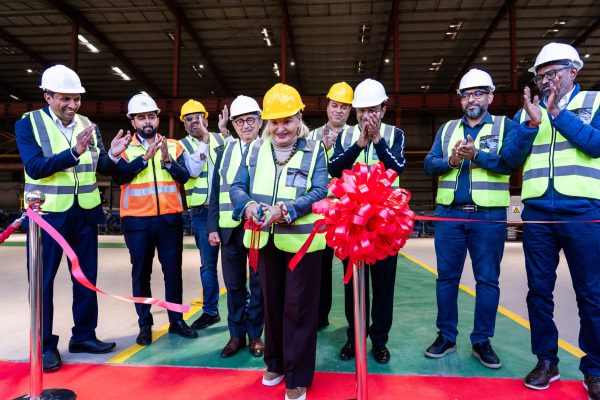


A PORTFOLIO of digital economy infrastructure projects with a total investment value of over R330 million was unveiled at the Eastern Cape Digital Economy Summit 2026, hosted by the East London Industrial Development Zone (ELIDZ) from 7-8 May.
The investments include a R76 million Tier III-aligned Data Centre funded by the Eastern Cape Provincial Government, a R65 million Business Process Outsourcing (BPO) and Shared Services facility supported by the Department of Trade, Industry and Competition (DTIC), and R181 million in broadband and undersea cable enablement driven through private sector investment. This is complemented by an R2.8 million Digital Hub implemented by ELIDZ through a public-private partnership and an R5 million Cisco EDGE Centre funded by private-sector partners.
Collectively, these investments reflect a coordinated funding model across government and industry, establishing an integrated digital platform to support industry, attract investment, and expand economic participation.
During the summit, delegates visited key sites within the Zone to engage directly with operational infrastructure positioned for immediate utilisation.
According to the ELIDZ, these developments build on the ELIDZ’s evolution from a platform for export-led industrialisation into a globally recognised Eco-Industrial Park, and now into a more integrated, digitally enabled operating environment.
Addressing delegates, ELIDZ Chief Executive Officer, Tembela Zweni, outlined the Zone’s transition to a Zone 4.0 operating model, in which industrial capability and digital infrastructure function as a single, coordinated system.
He emphasised that the digital economy in the Eastern Cape is no longer conceptual. It is operational, investable, and focused on execution. While the Zone’s core mandate to reduce risk, remove barriers, and accelerate investment remains unchanged, competitiveness now depends on access to reliable data systems, connectivity, skills, and innovation capacity within an integrated platform.
Five flagship projects
Within this framework, Zweni presented five flagship projects anchoring the Zone 4.0 model.
The Tier III-aligned Data Centre, developed at a cost of R76 million, serves as the digital backbone of the Zone. Designed to meet international standards, it delivers 99.982% uptime, operates on a carrier-neutral architecture, and has scalable capacity of up to 1MW across six data halls, aligned with ISO 27001, 27017 and 27018 standards. The facility enables secure, local hosting of government and enterprise systems, strengthens data sovereignty and supports data-driven industries. Government institutions, SOEs, and digital service providers are encouraged to localise and host systems within this facility.
The Digital Hub, supported by R2.8 million, is focused on innovation, incubation, and SMME development within the Science and Technology Park. It provides prototyping, testing, and commercialisation pathways, linking emerging enterprises to market opportunities. Public sector and industry stakeholders are encouraged to utilise the hub to develop solutions and collaborate with SMMEs.
The 800-seat BPO and Shared Services facility, backed by R65 million, is designed for global service delivery and integrated with the Zone’s digital infrastructure. It is expected to generate approximately 2,400 direct jobs through multi-shift operations, providing structured employment pathways for graduates and young professionals.
Operators, government, and enterprises are invited to establish and scale service operations within the facility.
The R181 million broadband and undersea cable enablement initiative strengthens connectivity by increasing bandwidth, reducing latency, and building resilient infrastructure. It enables direct integration into global digital networks, supporting high-performance operations across sectors. Telecommunications providers and infrastructure partners are encouraged to collaborate in expanding connectivity and network capacity.
The Cisco EDGE Centre, representing R5 million in private sector investment, focuses on building industry-aligned digital skills in areas such as networking, cybersecurity, and cloud computing. It supports workforce readiness, innovation and entrepreneurship. Public and private-sector stakeholders are encouraged to leverage this platform to develop talent pipelines aligned with industry demand.
Zweni noted that the full value of these investments lies in their integration, linking infrastructure, connectivity, skills, and innovation into a single operating environment that reduces fragmentation and accelerates implementation. He called on investors, operators, government institutions, and technology partners to move from interest to action to locate, deploy, partner, and scale within the ELIDZ ecosystem.