
WITHIN the coming months, rail reform will reshape South African logistics, a transformation with implications for regional trade, industrial growth and commercial competitiveness. For businesses across the Eastern Cape and the broader country, the prospect of private train operating companies (TOCs) taking to the tracks promises a vital, cost-effective alternative to road freight.
Yet, as the sector gears up for this new era, a very practical and formidable hurdle stands in the way: securing affordable and reliable locomotives.
Unlike standard gauge networks widely used in North America and China, where train sets roll off mass production lines with predictable regularity, South Africa relies on the narrower Cape Gauge. Because these locomotives are virtually custom-made to fit our regional dimensions, they carry a remarkably hefty price tag.
A capital challenge
The scale of capital required to mobilise private rail operations is immense. Mitchell Brooke, logistics development and special export program manager at the Citrus Growers Association of Southern Africa (CGA), has calculated that the association alone would need to invest approximately R125 billion in rolling stock to transport citrus along the vital Container Corridor between Johannesburg and Durban. This staggering cost projection is based on twelve new train sets operating in both directions on a 24-hour turnaround.
For private rail TOCs to be commercially viable, rolling stock needs to be available at manageable costs and under financing terms that institutional lenders can support. Because institutional lenders require predictable cash flows and clear risk allocation before backing multi-million-rand train sets, the prohibitive cost of brand-new equipment has triggered a worldwide search for suitable second-hand Cape Gauge rolling stock.
Refurbishment boom
This pressing equipment crunch has opened commercial opportunities for refurbishment specialists, engineering firms, and enterprising businesses seeking new roles in the logistics value chain.
The refurbishment of vintage or end-of-first-life locomotive frames offers a compelling commercial opening. Because Cape Gauge is widely used across sub-Saharan Africa, including South Africa, Mozambique, Botswana, and East Africa, there is regional demand.
Logistics and transportation group, Grindrod Limited, has demonstrated that older frames can be completely stripped, modernised with upgraded control systems, fitted with improved fuel efficiency, and equipped with modern safety technologies before being returned to service. This comprehensive renewal can be achieved at roughly half the cost of buying new, yielding financial savings of 50% to 55%.
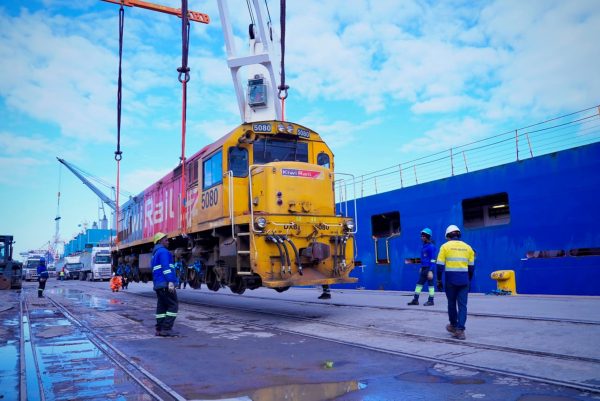
Similarly, Traxtion, one of Africa’s largest private rail freight and logistics operators, is investing heavily in rolling stock to supply both its own expanding operations and the broader market. The company finalised a robust R3.4 billion rolling stock investment programme, with R1.8 billion allocated directly to locomotives and R1.6 billion to wagons. As part of this initiative, Traxtion is bringing in 46 diesel-electric locomotives from KiwiRail in New Zealand, comprising 42 U26C units and 4 C30-8MMI units.
The first batch of eight units arrived at the Port of Durban at the end of July. Commenting on the long-term investment commitment required to build a rail fleet, James Holley, CEO of Traxtion, emphasised the need for collaboration between government and the private sector. He added, “Every investment of this nature creates a multiplier effect that extends beyond rail, supporting jobs, strengthening supply chains and enabling economic growth.”
Together, the 46-locomotive investment programme will expand freight rail capacity while supporting local engineering capability, refurbishment expertise and skilled employment through work undertaken in South Africa. The programme includes 78% local procurement and 60% local content, and creates 665 new permanent, highly skilled jobs, according to Traxtion.
The state’s role
Recognising that many new TOCs, such as the mining company Menar, the global shipping line MSC, and traditional road freight logistics groups, do not yet have established rail fleets and can lease from the likes of Grindrod and Traxtion, Transnet has also moved to make additional rolling stock available.
State-owned Transnet Freight Rail is working to create a pool of rolling stock for leasing by establishing a new private rolling stock leasing company, LeaseCo. Following the initial procurement stages, two private-sector partners are currently engaging with Transnet to become majority shareholders in LeaseCo, bringing vital capital, technical expertise, and operational capability to acquire, manage, and lease rolling stock.
Transnet is contributing a ring-fenced fleet of rolling stock assets as equity, alongside the manufacturing and engineering muscle of Transnet Engineering. While the exact volume of assets remains fluid as condition assessments are finalised with bidders, initial figures indicate a substantial pool of locomotives, bulk wagons, flatbeds, and fuel tankers to serve surging domestic and cross-border demand. Initial estimates were that 21,000 wagons and 1,000 locomotives would be available.
Transnet says it has already secured five agreements with TOCs for LeaseCo’s services.
A competitive new era
Transnet Freight Rail enters this competitive new era holding most of the infrastructure cards, retaining its core customer base while new operators are positioned as complementary services.
Transport Minister Barbara Creecy emphasises that these private TOC’s are essential to achieving national freight volume targets, such as raising rail performance to 250 million tonnes per annum, from the current 160 Mtpa, by 2030. She expects private TOC’s to start operating by April next year.
Traxtion’s rolling stock investment is expected to contribute capacity equivalent to approximately four and a half million tonnes, demonstrating both the significance of private sector investment and the scale of the opportunity that remains as the sector continues to open.
Holley says that, for reform to succeed, policy must be matched by investment. “The cost of trains means that businesses need to raise significant amounts of equity and debt. Equity investors into the sector need certainty which encourages long-term commitments.”
Version 4 of the Draft Network Statement, issued on 2 July was expected to be an important step towards creating that certainty.