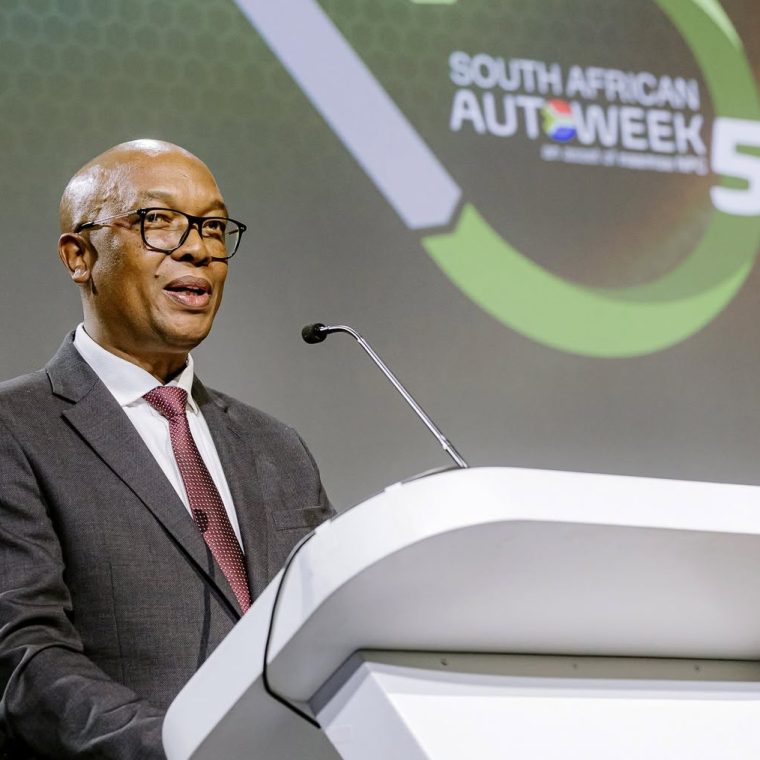

FOLLOWING the conclusion of its fifth edition of SA Auto Week, held in Durban last week, Naamsa | The Automotive Business Council welcomed the address delivered by the Minister of Trade, Industry and Competition, Parks Tau, on behalf of President Cyril Ramaphosa, on 15 October 2026 as part of the gathering.
In a statement issued on Monday, the Council said it particularly welcomes the President’s reaffirmation of government’s commitment to the South African automotive industry, the South African Automotive Masterplan 2035 (SAAM 2035), and the recognition that the industry’s long-term sustainability requires decisive, coordinated and time-bound policy interventions.
Naamsa said it further welcomes the constructive engagement, policy submissions, recommendations and commitments presented by government, vehicle manufacturers, component suppliers, organised labour, provincial governments and other industry stakeholders throughout South African Auto Week 2026. “Together, these contributions provide a strong foundation for strengthening South Africa’s automotive manufacturing competitiveness, accelerating industrial transformation, and positioning the country within the rapidly evolving global automotive landscape,” the Council stated.
Renewed commitment
“Government’s unequivocal commitment to the objectives of SAAM 2035 are welcomed, including increasing domestic vehicle production, deepening localisation, expanding employment and accelerating meaningful economic transformation.”
The Council said it recognises that the operating environment has changed substantially since the Masterplan was adopted in 2018. Intensifying global competition, technological disruption, changing export market requirements and domestic production cost pressures necessitate an urgent recalibration of policy instruments to ensure that the industry’s ambitions remain commercially achievable.
“The Council therefore welcomes the ongoing review of the Automotive Production Development Programme [APDP2] as a critical mechanism for restoring investment competitiveness, improving manufacturing scale and securing future vehicle production allocations.”
Immediate policy interventions
Naamsa said it particularly welcomes the policy directions outlined by Minister Tau, including:
- Strengthening domestic vehicle manufacturing: The proposed phasing out of existing Semi Knocked Down [SKD] operations, the withdrawal of policy support for new SKD facilities, with appropriate differentiation for medium and heavy commercial vehicles.
- Strengthen the definition of Completely Knocked Down: The strengthening of the legal definitions of Completely Knocked Down [CKD] manufacturing, to create deeper supply chains.
- Protecting South Africa’s strategic pickup truck manufacturing industry: naamsa welcomes the proposed ITAC investigation into the competitiveness of South Africa’s pickup truck (bakkie) manufacturing segment, a strategically important pillar of the country’s automotive industrial base. South Africa ranked 15th globally in light commercial vehicle production in 2025, accounting for approximately 1.2% of global output, and remains a significant manufacturing and export hub for internationally competitive pickup trucks, including the Toyota Hilux, Ford Ranger and Isuzu D-Max.
- The proposed investigation presents an opportunity to safeguard existing manufacturing investments, strengthen domestic production competitiveness, deepen localisation and reinforce South Africa’s position in global pickup truck value chains. Naamsa supports an evidence-based assessment of appropriate industrial policy measures, accompanied by reciprocal commitments to production, investment, employment, supplier development, transformation and exports.
- Addressing fiscal and taxation constraints: The engagement between the Ministers of Trade, Industry and Competition and Finance, and the instruction to technical teams to examine appropriate fiscal and taxation support mechanisms that balance industrial competitiveness with fiscal sustainability.
- Accelerating the new-energy vehicle transition: The recognition that differentiated support is required for NEV production and battery-related manufacturing, together with the proposed amendment of the NEV White Paper.
- Expanding future industrial opportunities: The focus on critical minerals beneficiation, battery value chains, hydrogen technologies, circular economy opportunities, end-of-life vehicle management and advanced digital manufacturing.
These policy directions are significant because they acknowledge that the future of South African automotive manufacturing depends not only on preserving existing industrial capacity but also on creating the conditions necessary to attract the next generation of automotive investment.
Contributions recognised
Naamsa acknowledges and welcomes the substantive contributions made throughout South African Auto Week 2026, particularly those addressing manufacturing competitiveness, localisation, industrial transformation, investment certainty, the NEV transition, trade competitiveness, infrastructure and logistics, and the development of domestic suppliers.
The Council recognises that these submissions reflect both areas of convergence and matters requiring further technical engagement. Differences in stakeholder positions should not diminish the shared commitment to maintaining a globally competitive and inclusive automotive manufacturing industry.
naamsa believes that the collective value of South African Auto Week 2026 lies in its ability to translate diverse stakeholder contributions into a coherent programme of industrial action.
The Council therefore supports the consolidation of submissions, agreed policy directions and outstanding technical matters into an implementation framework with clearly defined responsibilities, decision-making processes and timelines.
Transformation and inclusive industrial development
Naamsa welcomes the emphasis placed on transformation, particularly the recognition that the emerging automotive technologies and value chains must provide opportunities for black industrialists, women, young people, workers and emerging domestic suppliers.
The Council reiterates its commitment to advancing transformation beyond participation targets towards sustainable industrial ownership, productive enterprise development, supplier integration, procurement opportunities and long-term employment creation.
In this regard, naamsa supports the expansion of transformation initiatives and projects presented during South African Auto Week, including greater participation in battery manufacturing, charging infrastructure, power electronics and other emerging automotive technologies.
Implementation
While welcoming the address and the commitments emerging from the Indaba, naamsa emphasises that the industry’s immediate priority must now shift decisively from policy dialogue to implementation.
The investment decisions that will determine South Africa’s automotive manufacturing footprint between 2028 and 2035 are increasingly urgent. Policy certainty, manufacturing scale, production competitiveness and predictable regulatory frameworks are therefore essential to protecting existing investments and attracting new vehicle platforms.
naamsa stands ready to work with the Presidency, the DTIC, National Treasury, ITAC, provincial governments, organised labour and the broader automotive value chain to translate the outcomes of South African Auto Week 2026 into measurable industrial results.