


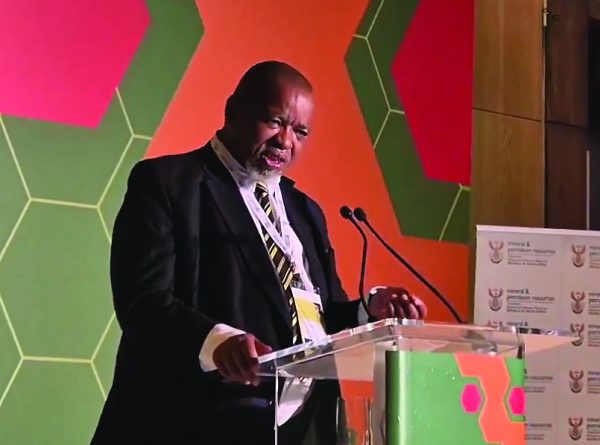

IN his address to the South African Fuels Forum in Johannesburg last week, Minister of Mineral and Petroleum Resources Gwede Mantashe (pictured) reiterated the newly reconfigured Department’s strategy to foster and advance both the mineral and petroleum sectors in five key areas.
He said the first and second priority areas are inextricably linked, aiming to promote investment and accelerate transformation by fostering an enabling policy and regulatory framework as well as implementing policies to facilitate greater participation of historically disadvantaged individuals.
He referred to the draft Petroleum Products Bill (PPB) published in October 2024, saying, “The bill seeks to institute efficient, cost-effective, broadly representative and competitive manufacturing, wholesaling and retailing of petroleum products in South Africa. Moreover, the bill aims to promote transformation and adherence to good industry practices within the South African petroleum products and liquid fuels sector.”
He said the department has consolidated stakeholder inputs to the bill and is preparing to submit the bill to Cabinet for approval prior to tabling it in Parliament before the financial year-end. “We are convinced that once the amendments to the Petroleum Products Act are made and enacted into law, this will not only drive transformation but also guarantee regulatory certainty in the industry.”
He pointed out that this is an addition to the seminal Upstream Petroleum Resources Development Act (UPRDA) of 2024.
“The enactment of the UPRDA is a culmination of the work initiated during the 6th administration aimed at separating petroleum issues from mining, thereby granting the petroleum sector autonomy from other industries. This, in turn, has paved the way for an orderly and ecologically sustainable development of the country’s petroleum resources. By the end of September this year, we will issue the regulations to provide the mechanisms for the implementation of the Act,” Mantashe said.
He said that efforts and interventions are being streamlined to support value addition close to the point of production. “At the heart of these initiatives lies the assurance of a secure liquid fuel supply to meet the country’s growing demand, with safeguarding local refining capacity being of utmost importance.
“It is essential to acknowledge that the world’s energy demand growth is still largely being met by fossil fuels, with petroleum being the primary source. The shutdown of refineries has resulted in significant disruptions to the supply chain. Chevron, BP, Shell and most recently TotalEnergies have all exited the refining business in South Africa. Petronas has also divested its refining and downstream interests in South Africa. As you may be aware, Shell is now finalising its divestment from the downstream sector in South Africa. Currently, Engen and Astron are now owned by international commodity traders, specifically Vitol and Glencore,” he said.
Mantashe told the forum that the country’s competitiveness hinges on evolving from a consumer of finished products to an active refiner of petroleum products. “Security of supply relies heavily on diversifying supply sources, which South Africa is maintaining to a large extent. Moreover, achieving security of supply necessitates a robust and efficient supply chain that can adapt to changes in demand fluctuations and respond to emergencies.
Security of supply
“In this context, we have established the South African National Petroleum Company (SANPC) as a Southern African petroleum champion, tasked with overseeing strategic planning, coordination, and governance of the country’s petroleum resources. The entity is expected to play a pivotal role in ensuring sufficient access to refined petroleum products, thereby fulfilling its mandate of providing security of liquid fuel supply to South Africa. We have set a strategic goal to operationalise the PetroSA’s gas-to-liquids (GTL) refinery and the South African Petroleum Refinery (SAPREF) within five years, which necessitates cooperation among industry stakeholders to ensure the security of liquid fuel supply.”
He said the department’s third priority is ensuring environmental sustainability by enhancing environmental compliance and enforcement. “Although South Africa has experienced significant investments in petroleum exploration in recent years, the primary challenge to these investments persists in the form of lobby groups and foreign-funded non-governmental organisations (NGOs) that continue to block the development of oil and gas, purportedly in the interest of environmental conservation.
“In this context, the environmental authorisation for Shell to drill up to five deep-water appraisal wells off the west coast is a welcome development. Several majors, including TotalEnergies, are also planning to explore off the west coast, where significant discoveries have been made in the Namibian Orange Basin, with potential extensions into South Africa’s waters.
“The publication of the biofuels strategy has triggered a surge in investment projects in the biofuels sector. Local biofuels manufacturing will confer benefits on the balance of payments and bolster fuel supply security, albeit to a limited extent. We expect the creation of jobs in feedstock production. The department has recently published a draft regulation for comment, which will provide certainty regarding biofuels pricing. We are cognisant that many of you are waiting for a blending pricing framework, which must be concluded within the current financial year,” Mantashe told the forum.
He said the fourth and fifth priority areas of the department are about promoting regional integration and cooperation by leveraging the bilateral and multilateral platforms, as well as strengthening institutional capacity and governance by enhancing organisational efficiencies to modernise and bring about responsiveness.

